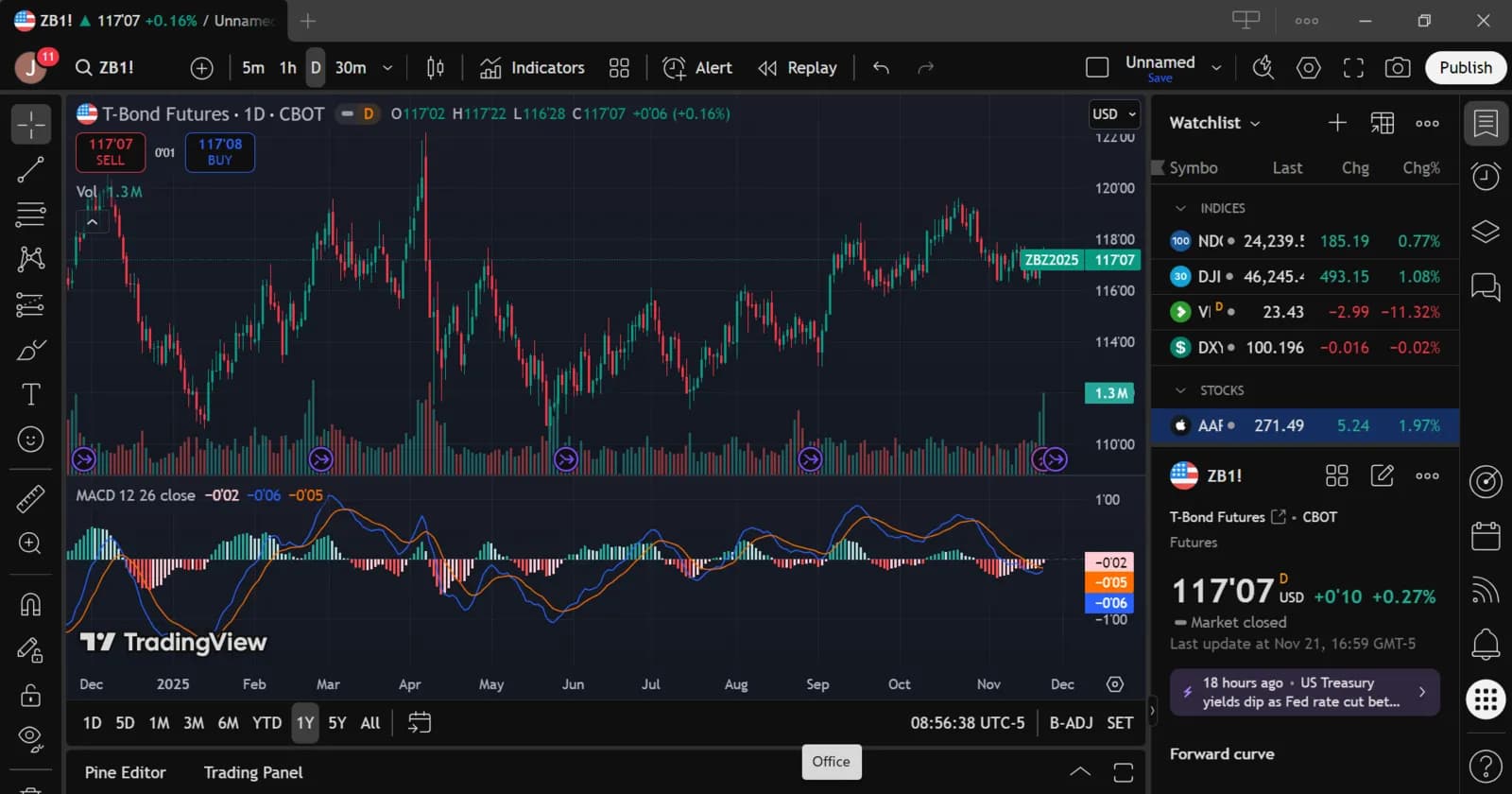


In trading, almost everything that matters is outside your control. You don't control the next candle, you don't control the central bank, you don't control liquidity at 3 a.m. or the headline that flips the market's mood. Strategies drift in and out of phase. Indicators work until they don't. AI models read the market more consistently than any human eye — and they still get it wrong, because the future is not in the data.
There is exactly one variable that depends entirely on you: how much you lose when you're wrong. That variable has a name — risk management — and it's the only edge no market, no headline and no algorithm can take away from you. This article breaks down its four layers: per-trade risk, maximum daily loss, lot caps and the kill-switch. At the end, we show how each one becomes a concrete setting in TraderClub.ai.
Why the math punishes anyone who ignores risk
Losses and gains are not symmetric. Lose 10% and you need to make 11.1% just to get back to zero. Lose half the account and you need to double what's left. This asymmetry isn't an opinion or pessimism: it's arithmetic — and it gets worse in a non-linear way as the hole deepens.
| Accumulated loss | Gain required to recover |
|---|---|
| -10% | +11.1% |
| -20% | +25% |
| -30% | +42.9% |
| -50% | +100% |
| -70% | +233% |
The practical reading of this table is simple: a trader's most important job is not maximizing the gain on each win — it's making sure no losing streak ever pushes them into the zone where recovery becomes statistically improbable. Every rule that follows exists for that.
Per-trade risk: the number that defines your survival
Per-trade risk is the percentage of your account you accept losing if the stop gets hit. It's not the lot size, and it's not the margin used: it's the distance between entry and stop-loss, converted into money, divided by your capital. A trade with a tight stop and a large lot can risk exactly the same as a trade with a wide stop and a small lot.
At 1% risk per trade, you would need dozens of consecutive losses to seriously damage the account — and long before that, any halfway serious strategy would already have been discarded. At 10% per trade, a handful of consecutive losses is enough, and consecutive losses happen to every method, in every market, in every month of the year.
- Set your maximum percentage per trade (0.5% to 1% is the classic range for beginners).
- Measure the distance in points between the signal's entry and its stop-loss.
- Calculate the lot backwards: lot size is the consequence of risk, never the starting point.
- If the calculated lot falls below your broker's minimum, the trade doesn't fit your account — skipping it is risk management, not cowardice.
Start with 0.5% to 1% per trade. It feels small until you go through your first streak of six straight losses — and every strategy goes through one. At 1%, that costs about 6% of the account. At 5%, it costs a quarter of your capital and most of your emotional balance.
Maximum daily loss: your day's circuit breaker
Bad days don't distribute losses evenly: they cluster. One stop leads to a second, the second leads to the urge to win the day back, and the urge to win it back leads to the trade that was never in the plan. That's the tilt cycle — and it spares neither beginners nor veterans.
A maximum daily loss cuts that cycle at the root: hit the limit, the day is over. No last trade. Over. A common reference is 2% to 3% of the account — enough room for two or three full stops within your per-trade risk, and tight enough to keep one bad day from turning into a week of recovery. The point is not punishment: it's recognizing that after a losing streak, the one trading is no longer your process — it's your frustration.
Lot cap: protection against your best idea
The lot cap limits the maximum size of any position, regardless of how much conviction you have. It sounds redundant next to per-trade risk, but it covers a different angle: the day you are certain. Conviction doesn't change probability — and the biggest losses in any trader's history almost always carry the signature of a certainty.
The cap also protects against operational mistakes: an extra zero in the volume, a forgotten stop, a wrong setting in the terminal. With a hard lot limit, your worst typo has a known maximum size — and surviving operational errors is risk management too.
Get the next ones
One article a week, straight to your inbox. No spam.
The silent layer: correlation and total exposure
The four layers take care of each trade and each day — but there is a risk that cuts across both dimensions: correlation. Three open positions in pairs that move together are not three 1% trades; in practice, they are a single 3% trade in disguise. The market doesn't ask how many orders you opened — it asks what your net exposure is when everything moves in the same direction at the same time.
That's why one question is worth adding to the routine before every entry: if all my open positions hit their stops at the same time, how much do I lose? If the answer exceeds your maximum daily loss, you are already trading above your own limit — you just haven't noticed yet. Total exposure is the lot cap of the entire portfolio.
Kill-switch: the decision you make before you need it
A kill-switch is the mechanism that automatically shuts down new entries when a limit is breached — daily loss reached, drawdown exceeded, behavior off-plan. The key word is automatically: the rule executes without consulting you, because the moment it fires is precisely the moment your judgment is at its worst.
Nobody makes good decisions in the middle of a drawdown. The best risk decisions are made with a cool head, days in advance — and executed by code, not willpower.
That's why a kill-switch matters more than discipline. Discipline is a finite resource that runs out on exactly the days you need it most. Code doesn't get tired, doesn't get frustrated, and doesn't believe this time is different.
A good kill-switch operates on more than one horizon: the daily one protects your day; the drawdown one protects your account. If the week's or month's accumulated losses cross a pre-defined ceiling, the system stops — and the forced pause becomes the moment to calmly review the process, not to double down to compensate.
How to configure all of this in TraderClub.ai
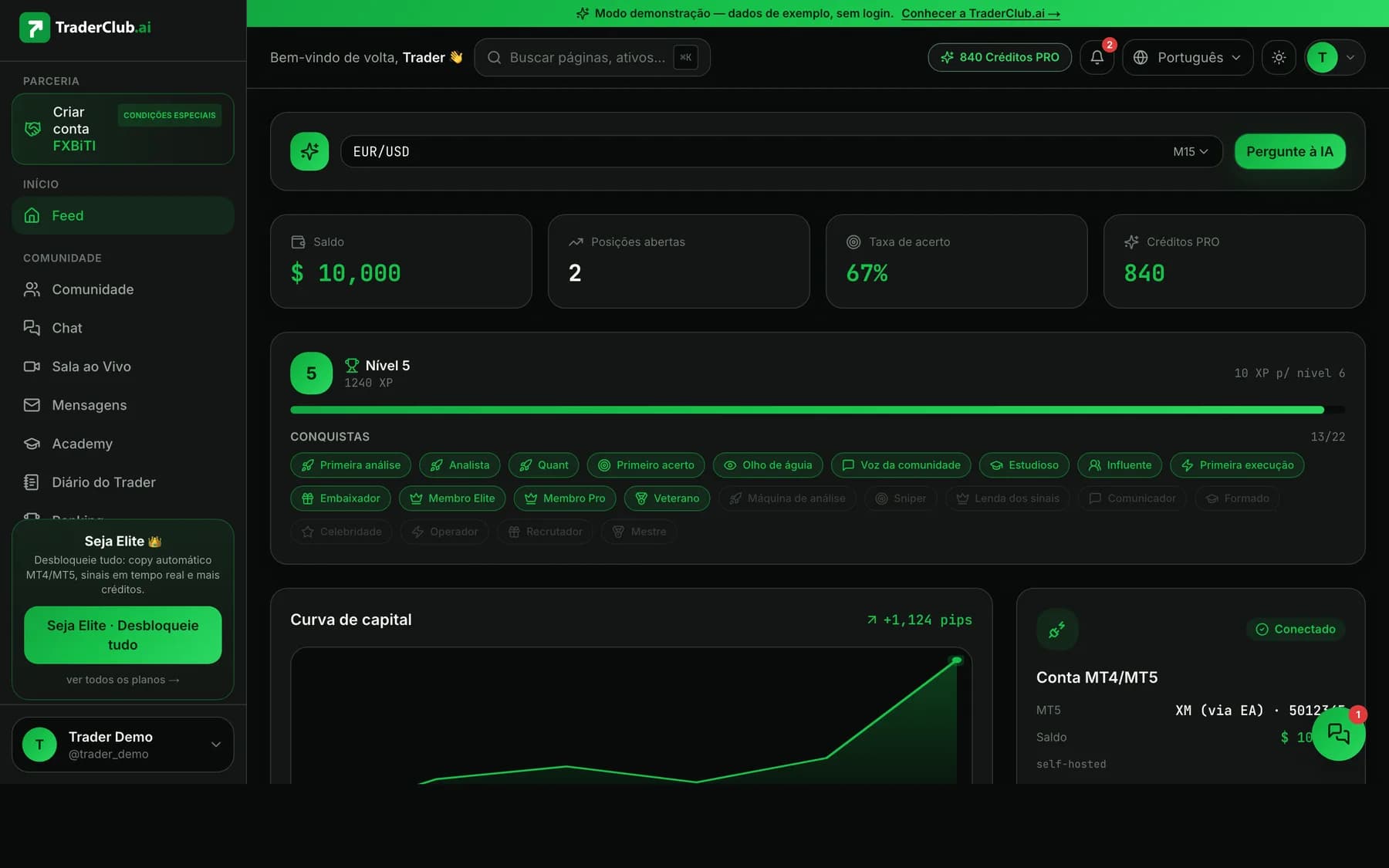
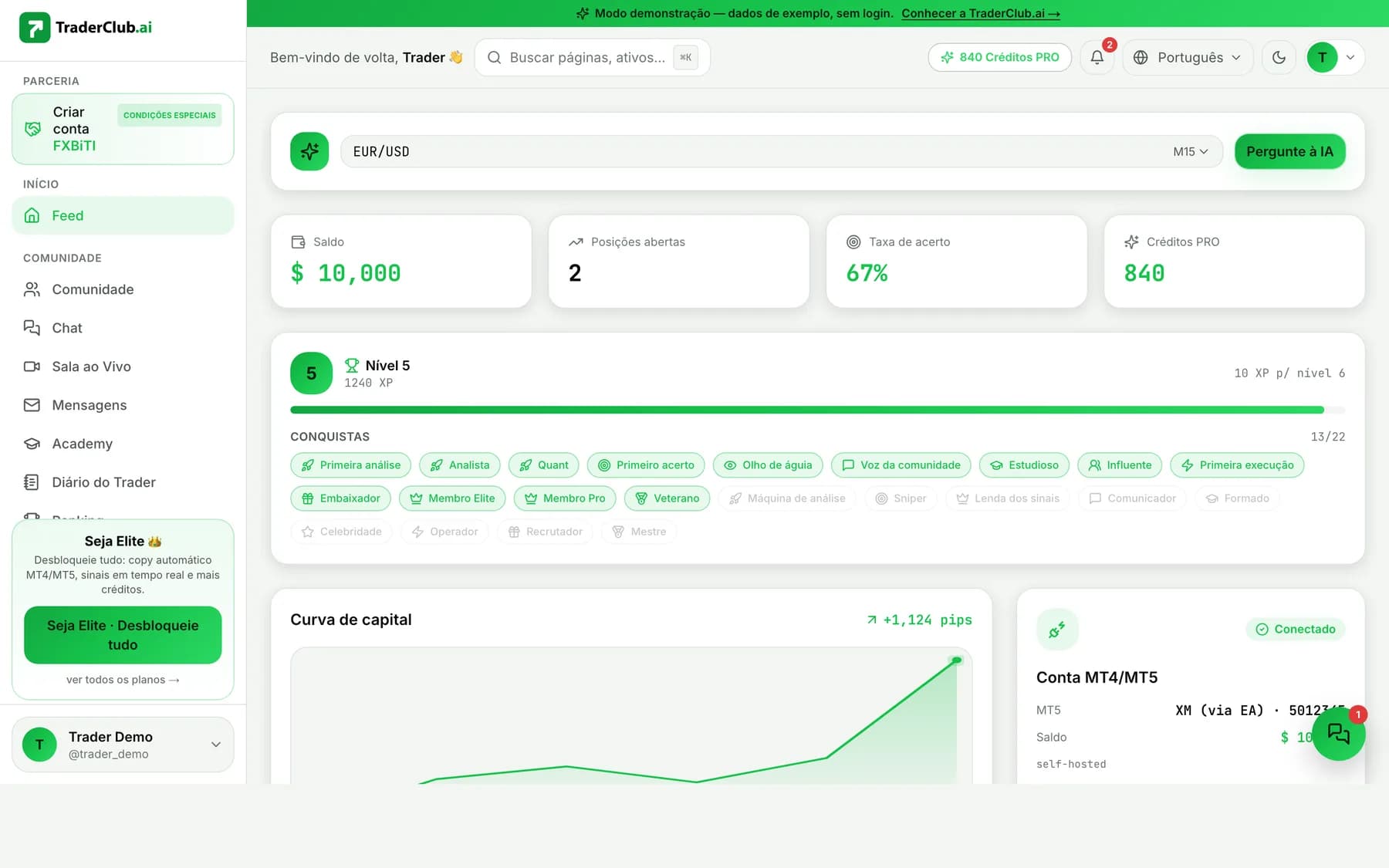
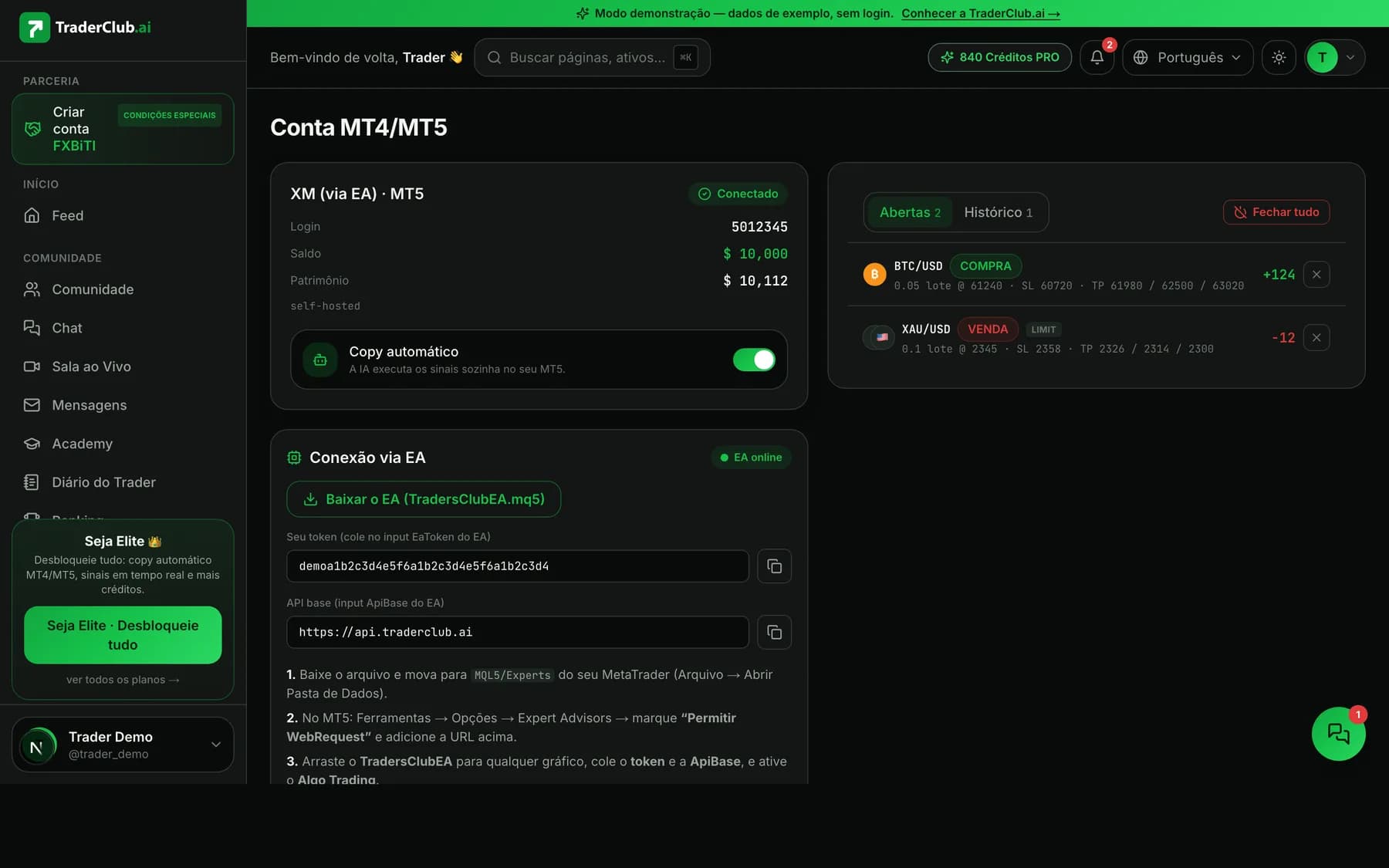
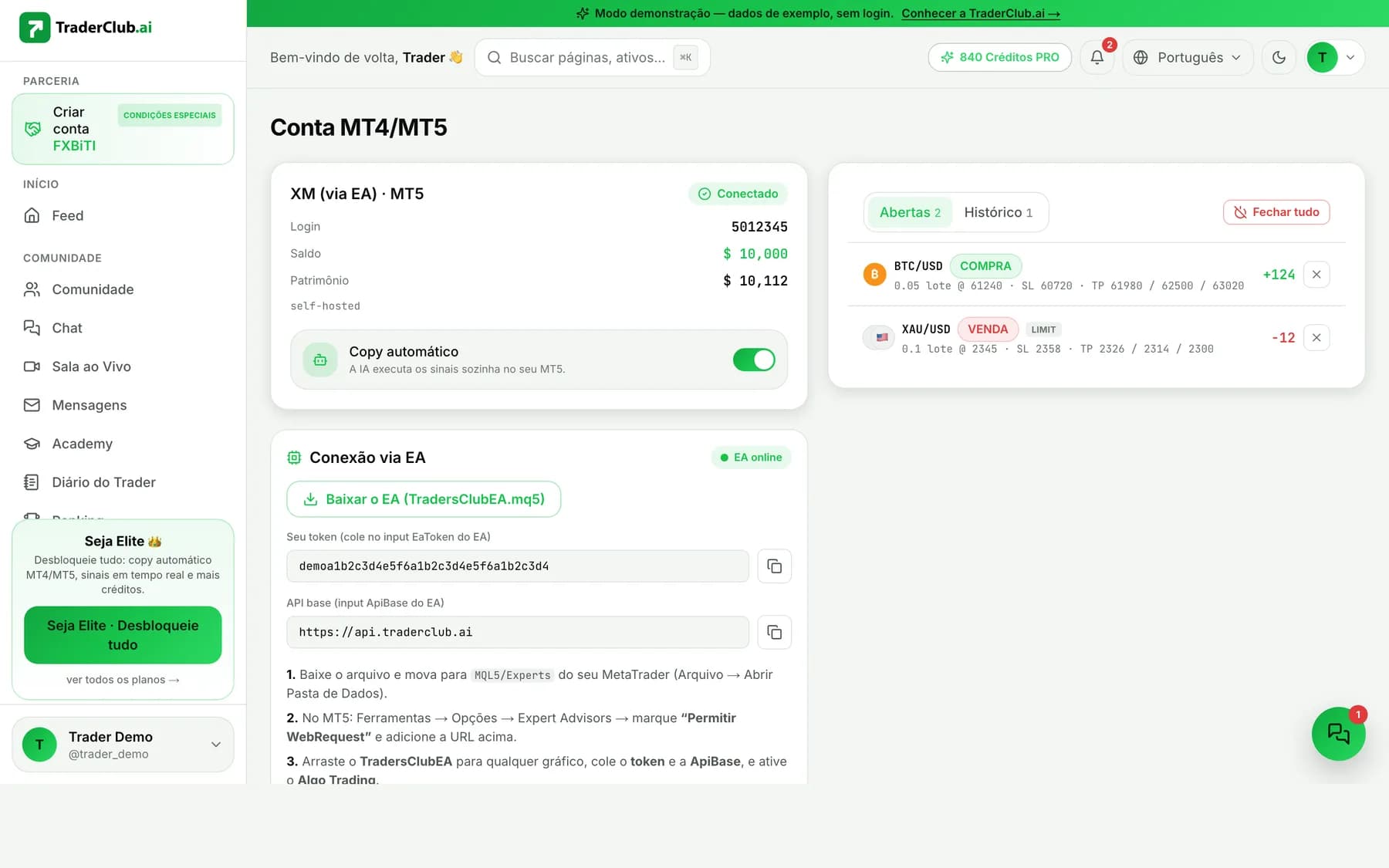
In TraderClub.ai, these four layers aren't e-book advice — they're settings on the EA that runs on your own MetaTrader 5. Execution is zero-custody: your capital stays at your broker, in your account, and the limits are enforced locally, before any order is sent.
- Per-trade risk: you set the percentage and the EA calculates the lot automatically from each signal's stop.
- Maximum daily loss: once the day's limit is hit, the EA stops opening new positions until the next session.
- Lot cap: no order goes out above your defined maximum volume, whatever the signal says.
- Kill-switch: breach a limit and it shuts off. Reactivating requires a manual action from you — with a cool head.
Extra layer: TraderClub.ai's AI (Claude) applies a risk veto during macro event windows — rate decisions, payrolls, CPI. Signals that fall inside those windows are held, because spread and slippage in those moments destroy the math behind any stop.
What risk management does not do
Mandatory honesty: risk management does not turn a bad strategy into a profitable one. If the method has no edge, the limits merely guarantee you find that out slowly, with your account still alive — which, frankly, is already a lot. It also doesn't eliminate risk: markets involve loss, always, for every participant, with every tool.
What it does is something else: it guarantees that no single day, no single week and no losing streak ever has the power to end your story in the market. Survival isn't trading's final goal — but it's the prerequisite for all the others.
Risk limits shouldn't depend on willpower at 3 p.m. on a bad Thursday. In TraderClub.ai they are configuration — enforced by the EA on your MT5, with zero custody of your capital.
Risk warning: trading in financial markets involves real risk of loss, including the possibility of losing all invested capital. No risk-management tool eliminates that risk. This content is educational and does not constitute investment advice.