

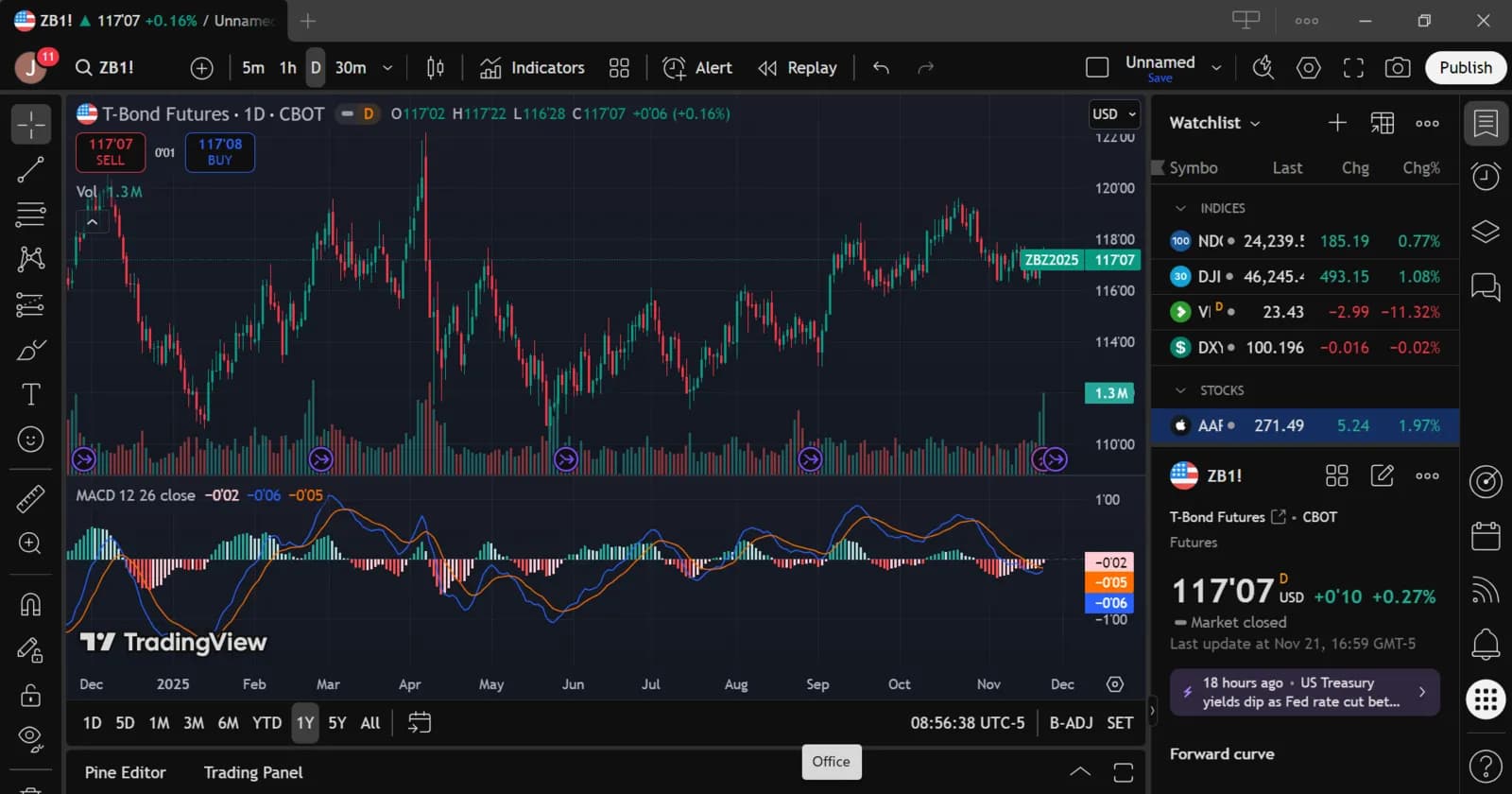
There is a chasm between talking about “artificial intelligence in trading” and describing, precisely, what such a system does at 9:04 on a Tuesday morning, when the market opens heavy and three assets fire alerts at the same time. The speech is easy. The practice is made of small decisions, repeated thousands of times, under rules that do not change their mood with the day. This article is about that practice.
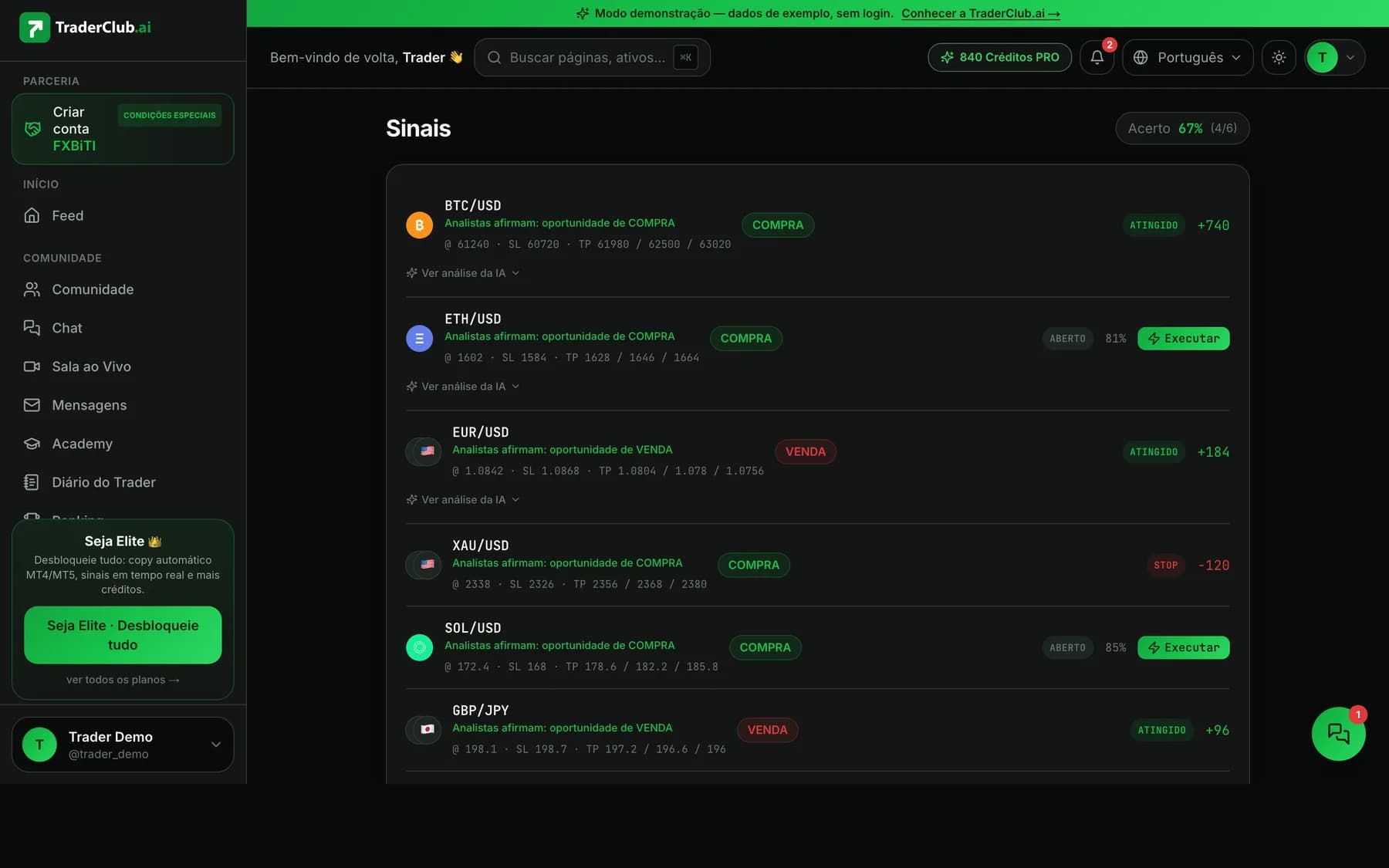
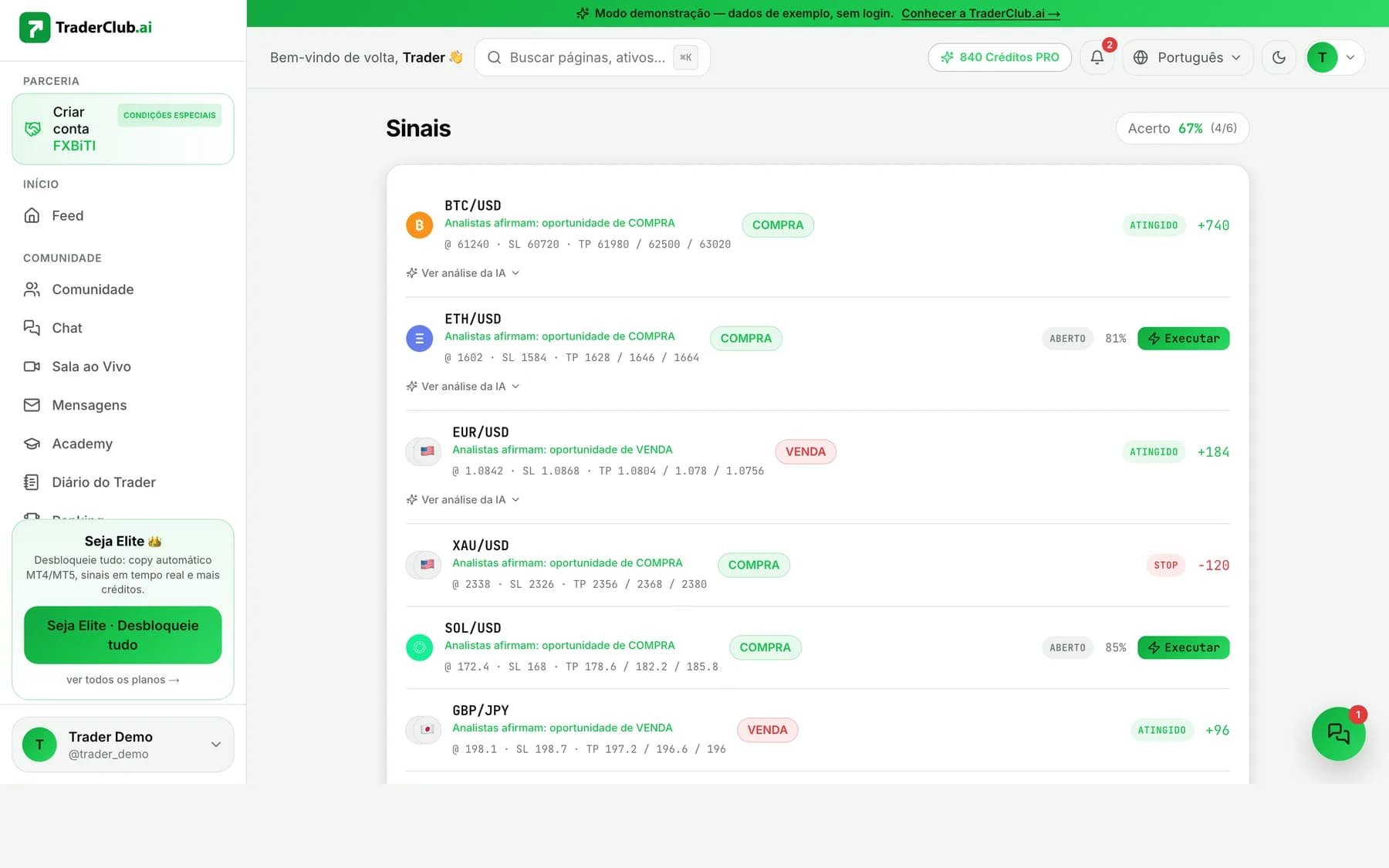
At TraderClub.ai, the AI is not an oracle that “predicts the market” — nobody predicts the market consistently, and you should be suspicious of anyone who promises to. What the software does is more modest and, precisely for that reason, more useful: it runs a disciplined analysis process, the same process, on every asset, on every candle, without fatigue, without ego, and without the temptation of “just one more entry” after a bad day.
What changes when analysis becomes software
An experienced trader looks at a chart and sees layers: trend, momentum, exhaustion, context. Seeing was never the problem — repeating was. The classic failures of discretionary trading are always the same: entering off-plan, widening the stop mid-pain, doubling the position to “make it back”. None of these failures is analytical. All of them are execution failures, and all of them are born from emotion.
When analysis becomes code, three things change in nature. First, it becomes repeatable: the read that held yesterday holds today, for any asset, exactly the same. Second, it becomes auditable: every signal is recorded with its entry, stop and target, and can later be checked against what the market actually did. Third, it detaches from the emotions of the person trading — the system does not know whether you are up or down on the day, so it does not change behavior at the worst possible moment.
Confluence: four indicators, one decision
The core of TraderClub.ai's analysis is confluence: no single indicator, on its own, authorizes a signal. The AI combines four classic reads — EMA, RSI, MACD and ADX — and only considers a setup when they tell the same story. An isolated indicator produces noise; confluence filters it.
- EMA (exponential moving averages) sets the direction: price is trading above or below the recent consensus, and with what slope.
- RSI measures the stretch: a move in the right direction that is already overbought is a worse signal than it looks at first glance.
- MACD tracks momentum: what matters is whether the strength behind the move is building or draining away.
- ADX qualifies the trend: below a certain level, what looks like a trend is a ranging market — and ranges eat stops.
| Indicator | What it measures | The question it answers |
|---|---|---|
| EMA | Trend direction and slope | Is price above or below the recent consensus? |
| RSI | Speed and amplitude of the move | Is the move too stretched to enter now? |
| MACD | Momentum and shifts in strength | Is the force behind the move growing or dying? |
| ADX | Trend intensity | Is there a real trend, or just sideways noise? |
The golden rule of confluence is accepting missed opportunities. A system that demands multiple confirmations enters fewer times than an anxious trader — and that is exactly the point. The cost of sitting out a move is always smaller than the cost of trading noise with real money.
Multi-timeframe: the H1 confirmation
Indicators aligned on a short timeframe can still tell a false story. A beautiful breakout on the 5-minute chart may be nothing more than a bounce inside a larger decline. That is why every setup approved by confluence passes through a second gate: confirmation on the 1-hour chart (H1).
The question H1 answers is simple: is the short-term move with the tide or against it? Signals aligned with the higher timeframe tend to have more room to run; signals against the tide demand perfect timing — and perfect timing is not a strategy, it is luck with better marketing.
If you trade manually, steal this rule: before any entry on the short chart, open the H1 and say out loud which side the trend is on. If the answer takes too long, the answer is “don't trade”.
Get the next ones
One article a week, straight to your inbox. No spam.
The risk veto: the part of the AI that says no
The most underrated part of the system generates no signals at all — it cancels them. Before a signal is published, a separate AI layer (built on Anthropic's Claude) evaluates the context: is there a relevant macro event inside the window? A rate decision, payrolls, CPI, a central bank speech? In those windows, the market stops responding to technicals and starts responding to headlines.
When the window is dangerous, the veto kills the signal — even with perfect confluence, even with H1 aligned. It is counterintuitive for beginners and frustrating for anyone who craves action. But it is the difference between a system designed to always be trading and a system designed to last.
The right question is never “how much can this signal make?”. It is “what happens to the account if this read is wrong?”. Everything else comes after.
In practice, the veto turns the economic calendar into part of the analysis. The average manual trader finds out about payrolls when the candle explodes on screen. In those windows, the system simply was not positioned.
Zero-custody execution: the robot on your account, the money with you
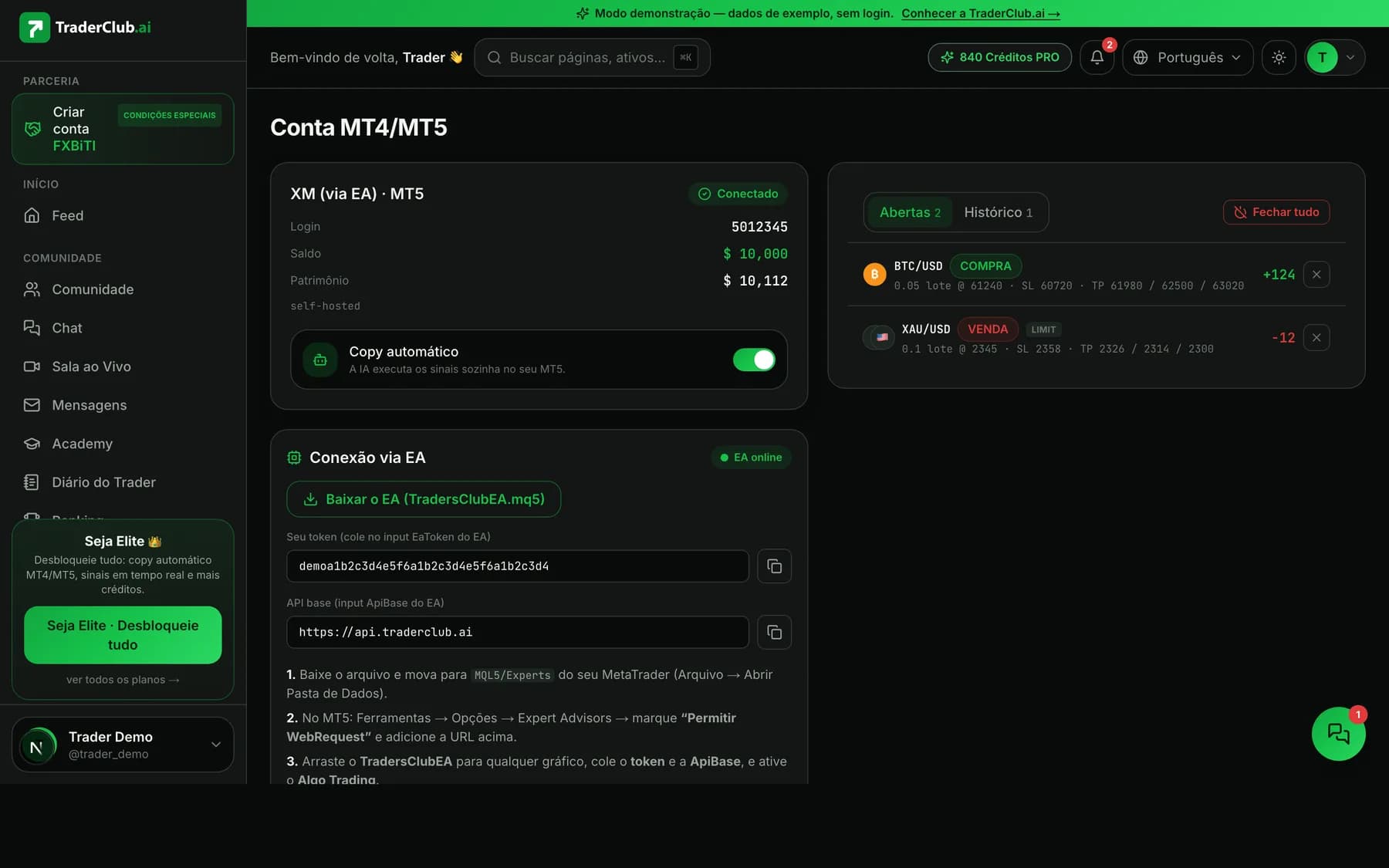
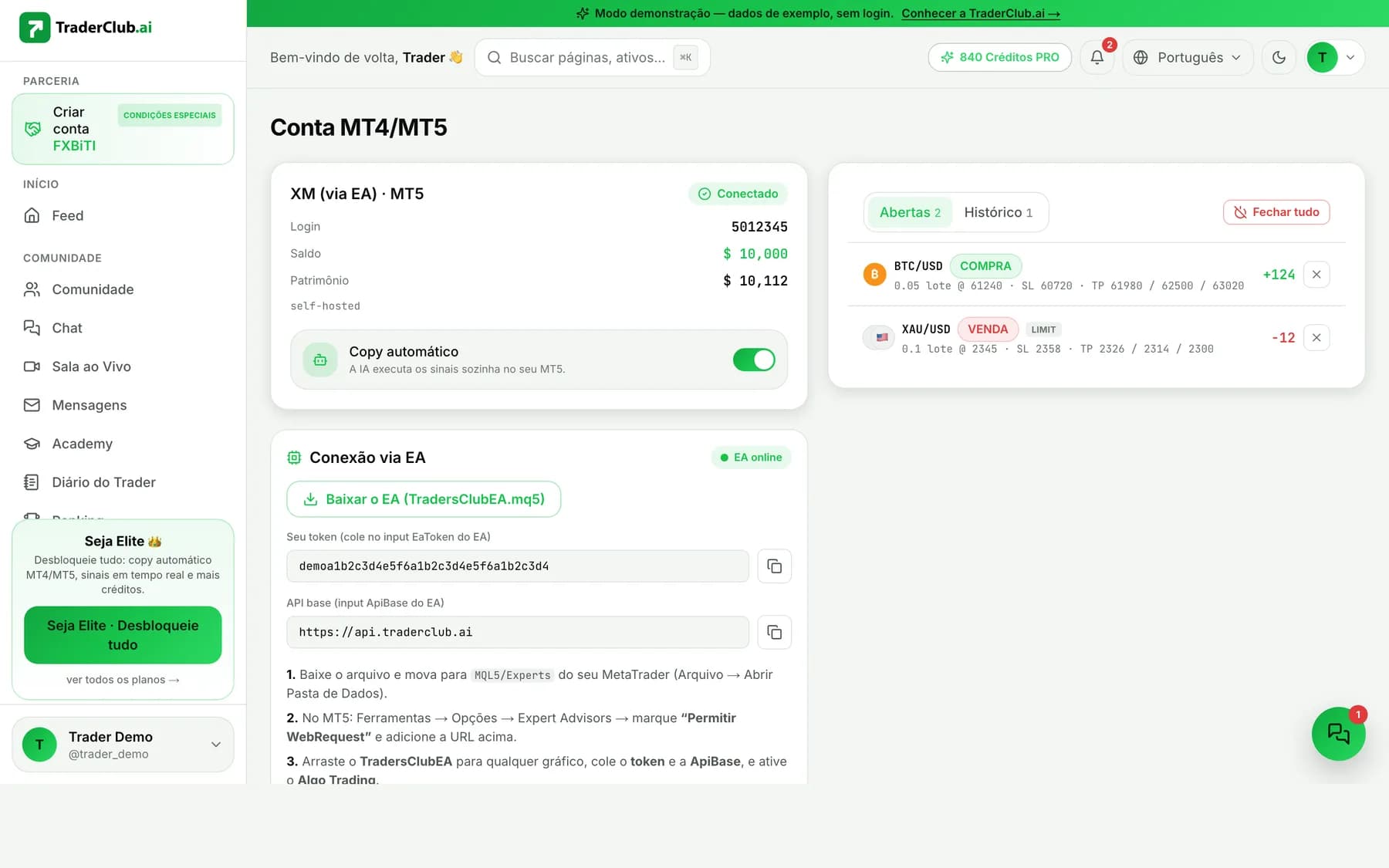
Good analysis with bad execution is still a bad outcome. The final leg of TraderClub.ai is an Expert Advisor (EA) installed on the user's own MetaTrader 5. Approved signals reach the EA and are executed on your account, at your broker, within the limits you configured.
This has a name: zero custody. TraderClub.ai takes no deposits, holds no balances, intermediates no one's funds. If you switch the EA off, nothing else gets executed. If you cancel the subscription, your money stays exactly where it always was — at your broker.
- You set position sizing and risk limits on your MT5 — the EA respects what you configured.
- No access to your balance or withdrawals: the platform sends orders, it does not move money.
- Natural auditability: every trade shows up in your own broker's history, not on a dashboard controlled by a third party.
Public track record: numbers nobody gets to edit
The cheapest promise in the signals market is the results screenshot. A screenshot has no context, no sequence and — above all — none of the trades that went wrong. That is why TraderClub.ai keeps a public track record where every signal is resolved automatically against the market's real candles: it hit target, hit stop, or expired. No manual curation, no deleting a bad week.
Every resolution is written to a hash-chained ledger — each record carries the signature of the previous one. Tampering with an old result would visibly break the entire chain. It is the same integrity principle used in audit systems: it is not that nobody wants to edit; it is that editing leaves a mark.
The public track record shows the system's verifiable past — including the losing streaks. It exists so you can evaluate the process with data, not as a guarantee of future results.
What the software does not change
Honesty requires saying what the AI does not do. It does not eliminate losses: streaks of stopped-out trades are part of any strategy, with or without software. It does not predict black swans. It does not turn a small account into a fortune — whoever promises that is selling something else. And it does not replace the most important decision, which remains human: how much of your capital you expose, and whether you should be trading at all.
- Losses still exist — the goal of the process is to discipline them, not to abolish them.
- Past results, even auditable ones, do not guarantee future results.
- Position sizing and risk tolerance are your decisions, made before any signal.
What changes, in the end, is the terrain of the fight. Instead of wrestling your own anxiety for discipline at 9 a.m., you coldly evaluate a process: do the rules make sense? Does the auditable history support what the sales page claims? Does the risk per trade fit your reality? Those are better questions — and better questions are, honestly, the most any serious tool can offer.
Want to see this process at work? The AI page shows how signals are built — and the public track record shows what happened to each one of them, hits and misses included.
Risk warning: trading financial markets involves substantial risk of loss and is not suitable for all investors. Signals and analyses are educational and informational and do not constitute investment advice. Past results do not guarantee future performance. Only trade with capital you can afford to lose.