

The internet is full of extraordinary results. Screenshots of multiplied accounts, equity curves that only go up, win rates no institutional fund on the planet can sustain. And almost none of it survives one simple question: how do I verify this?
This article is a practical guide to skepticism. What exactly makes a result verifiable, why screenshots rigorously prove nothing, how automatic resolution against real market data works, what a hash-chain ledger guarantees (and what it doesn't) — and why no percentage means anything without a minimum sample behind it.
The cost of fabricating a result is zero
Start with an uncomfortable fact: producing a convincing profit screenshot costs nothing and takes minutes. A demo account generates a history visually identical to a real one. An image editor adjusts any number. And you don't even need sophisticated bad faith — selection is enough: run ten accounts, show the one that worked, delete the other nine.
- A demo account presented as real — the history looks identical.
- Period cherry-picking: show the good quarter, omit the bad year.
- Account cherry-picking: ten accounts opened, only the winner becomes a post.
- Hidden martingale: the curve rises smoothly until the day the account vanishes.
- Direct editing: changing numbers in a screenshot is trivial and undetectable.
None of this is illegal in most cases, which is exactly why the problem persists. The only defense is structural: demand results that do not depend on the honesty of whoever presents them.
And there is the bias nobody fabricates on purpose: survivorship. The profiles that blew up vanish from social media; the ones that got lucky keep posting. The feed you see is not a sample of what happens to people who trade — it's a sample of who survived long enough to post. Without adjusting for that filter, even an honest observer overestimates what is possible.
The four properties of a verifiable result
A track record worthy of the name needs four properties — and the absence of any one of them invalidates the whole:
- Recorded before the outcome: the signal must be published with entry, stop and target before the market moves — a public timestamp, not personal trust.
- Resolved by an independent source: what decides whether it worked is the market's real price, not whoever published the signal.
- Complete history: every signal counts, including — especially — the ones that failed. A curated history is not a history.
- Auditable immutability: once recorded, a result cannot be edited or deleted without leaving a detectable trace.
Screenshots fail all four. Spreadsheets fail three. Most of the results circulating in signal groups fail every single one.
Notice that none of the four properties requires trusting anyone — that is the essence. Verifiability is not a moral quality of whoever publishes; it's a technical property of the system that records. Honest people with fragile systems produce unverifiable histories; robust systems produce auditable histories even in the hands of people you've never met in your life.
Automatic resolution against exchange candles
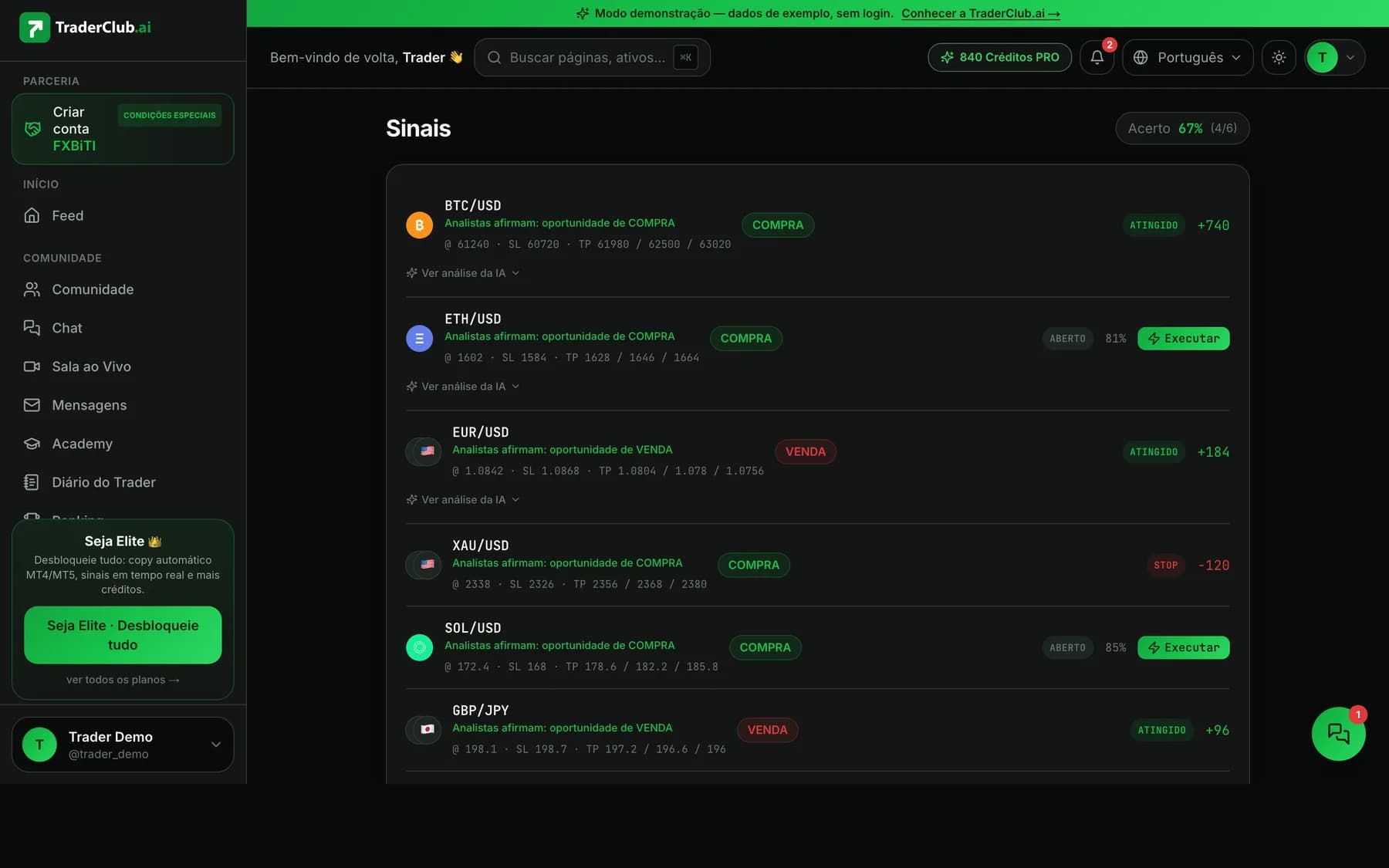
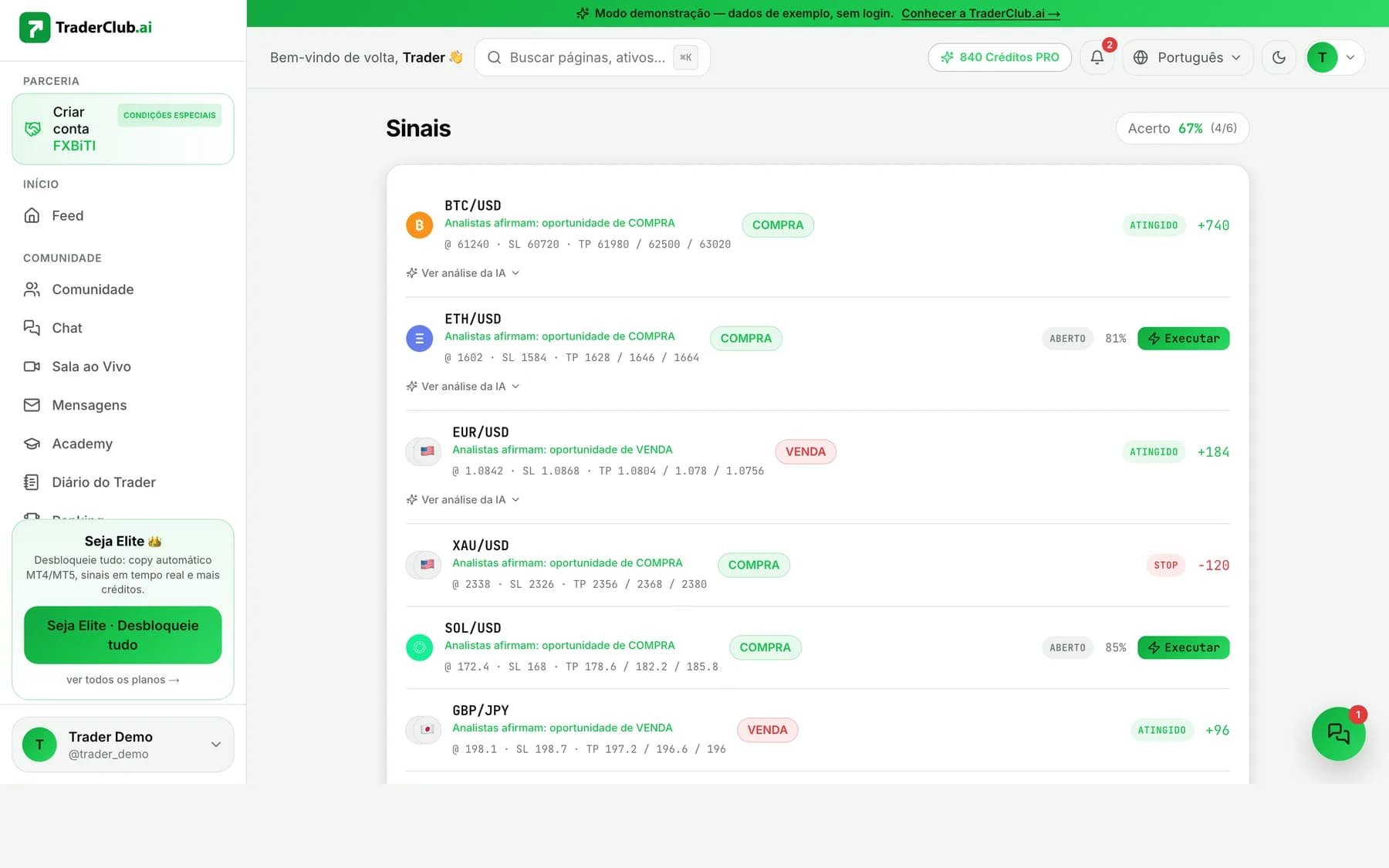
In TraderClub.ai, every signal is resolved automatically: the system compares entry, stop-loss and take-profit against the exchange's real candles, and the outcome — win, loss or expired — is determined by the data, not by a human. Nobody on the team marks a result. Nobody rounds. If price touched the stop before the target, it's a recorded loss, full stop.
This eliminates the single most common class of manipulation in the signal market: the result reinterpreted after the fact. The almost hit the target, the if you had just held on, the losing signal that quietly becomes cancelled. Against real candles, there is no almost.
Why candles? Exchange OHLC candles are public, reproducible and verifiable by anyone with access to the same data. Anyone can reprocess the history and arrive at the same outcome for every signal — that's what turns transparency into something auditable, rather than a promise.
Get the next ones
One article a week, straight to your inbox. No spam.
Hash-chain ledger: a history that refuses edits
Resolving against real data protects the present. But what about the past? What stops someone from editing old records when nobody is looking? This is where TraderClub.ai's hash-chain ledger comes in: every result record carries the cryptographic hash of the previous record, forming a continuous chain back to the very first signal.
The practical consequence: altering any old record changes its hash, which breaks the link with every record that follows. Tampering isn't merely forbidden — it becomes mathematically visible. It's the same structural principle as a blockchain, applied to the specific problem of keeping a trade history safe from silent revision.
What the hash-chain does not guarantee — and honesty requires saying it: it doesn't prevent the original record from being wrong. That's what automatic resolution against candles is for. The two layers complete each other: one ensures the result is born from the data; the other, that it stays exactly as it was born.
Minimum sample: when a percentage starts to mean something
An 87% win rate means nothing on its own. In small samples, variance dominates any signal: a fair coin flipped ten times produces seven heads surprisingly often. A mediocre method can shine for twenty trades; a solid method can cross fifteen grim ones. Neither period, in isolation, says much.
| Trades in the sample | What you can conclude |
|---|---|
| 10–20 | Practically nothing — luck dominates the outcome |
| 50 | An early trend, still fragile and reversible |
| 100–200 | Patterns start holding up statistically |
| 500+ | Consistency with real statistical relevance |
And a win rate alone is still half a truth: a method with a 40% win rate and average wins three times larger than its losses beats one with an 80% win rate that gives everything back in a single wide stop. Always evaluate the pair — win rate and payoff — over a sample that deserves the name.
Rule of thumb: distrust any percentage presented without the number of trades next to it. Those who have a sample show the sample. Those who don't usually have a reason.
Language red flags: what the copy reveals before the numbers do
Even before auditing data, the vocabulary gives a lot away. Fabricated results tend to arrive wrapped in the same speech patterns — and recognizing them can save you even the checklist's five minutes.
- Artificial urgency: last spots, today only — verifiable data has no expiration date.
- Guaranteed income or 100% consistency: no honest market participant guarantees returns; whoever guarantees, hides.
- Returns with no risk mentioned: whoever shows gains and never mentions drawdown is telling half the story.
- Attacking skepticism: lines like doubters never prosper — auditable systems invite doubt instead of punishing it.
None of these signs proves fraud on its own. But the correlation is high enough to work as a first-pass filter: when the pitch needs to shout, it's usually because the data cannot speak.
Checklist: audit any track record in five minutes
- Are signals published before the move, with a verifiable timestamp?
- Is resolution automatic, against independent market data?
- Does the history include every loss, or only the good months?
- Are old records immutable — or silently editable?
- Is the sample large enough (hundreds of signals, not dozens)?
- Does the win rate come with the average payoff?
- Can you verify all of this yourself, without asking anyone for anything?
Seven questions, five minutes. Most results out there don't survive the second one. And not by accident: verifiable transparency takes engineering work, while hide-and-seek pays in marketing.
Transparency as architecture, not as a slogan
If a result cannot be audited, it is not a result. It is a story.
That is the standard TraderClub.ai used to build its own track record: public, automatically resolved against real candles, hash-chained, with losses visible in the same table as the wins. Not because always-pretty numbers sell — they aren't always pretty, and that is precisely the point. A history without losses isn't a good history: it's a fake one.
The standard applies for us and against us — anyone, subscriber or not, can open the history and check. That's how we think the entire market should work. Until it does, the audit tool is yours: the seven questions above belong to no one.
Don't take our word for it — that is literally this article's thesis. Open the public track record, look at the losses next to the wins, and check the chain of records for yourself.
Risk warning: past results, even verifiable and auditable ones, do not guarantee future results. Trading in financial markets involves real risk of losing invested capital. This content is educational and does not constitute investment advice.