

Most guides on how to start trading fail at one of two extremes: they either promise financial freedom in thirty days, or they're so generic they never tell you what to actually do on Monday morning. This roadmap tries the middle path: four weeks, one clear goal per week, and honest expectations about what is possible in that time.
Expectations spoiler: in four weeks you will not be living off trading. You'll build something more valuable — a process. Demo first, then reading signals, risk before returns, and a first real trade small enough to be a lesson, not a bet.
Before you start: the expectations contract
Three truths to sign off on before week one. First: most people lose money trading — anyone telling you otherwise is selling something. Second: four weeks is enough to build a serious process, not to validate an edge; validation takes hundreds of trades. Third: the goal of these four weeks is to end with your capital intact, your process assembled and data about your own behavior. That's all. And that's already a lot.
Where does AI fit into this? TraderClub.ai's AI analyzes indicator confluence (EMA, RSI, MACD, ADX), confirms signals against the H1 timeframe and vetoes signals during macro event windows. It organizes information and disciplines the process — what it does not do is predict the future or guarantee results. A tool, not an oracle.
Week 1 — Demo, platform and vocabulary
This week's goal: zero trades. Seriously. Open a demo account at a broker with MetaTrader 5, install the platform and spend the week learning the geography of the terrain: where orders live, what a lot is, how a pip is measured, what margin and leverage mean — and why leverage is the reason the demo comes first.
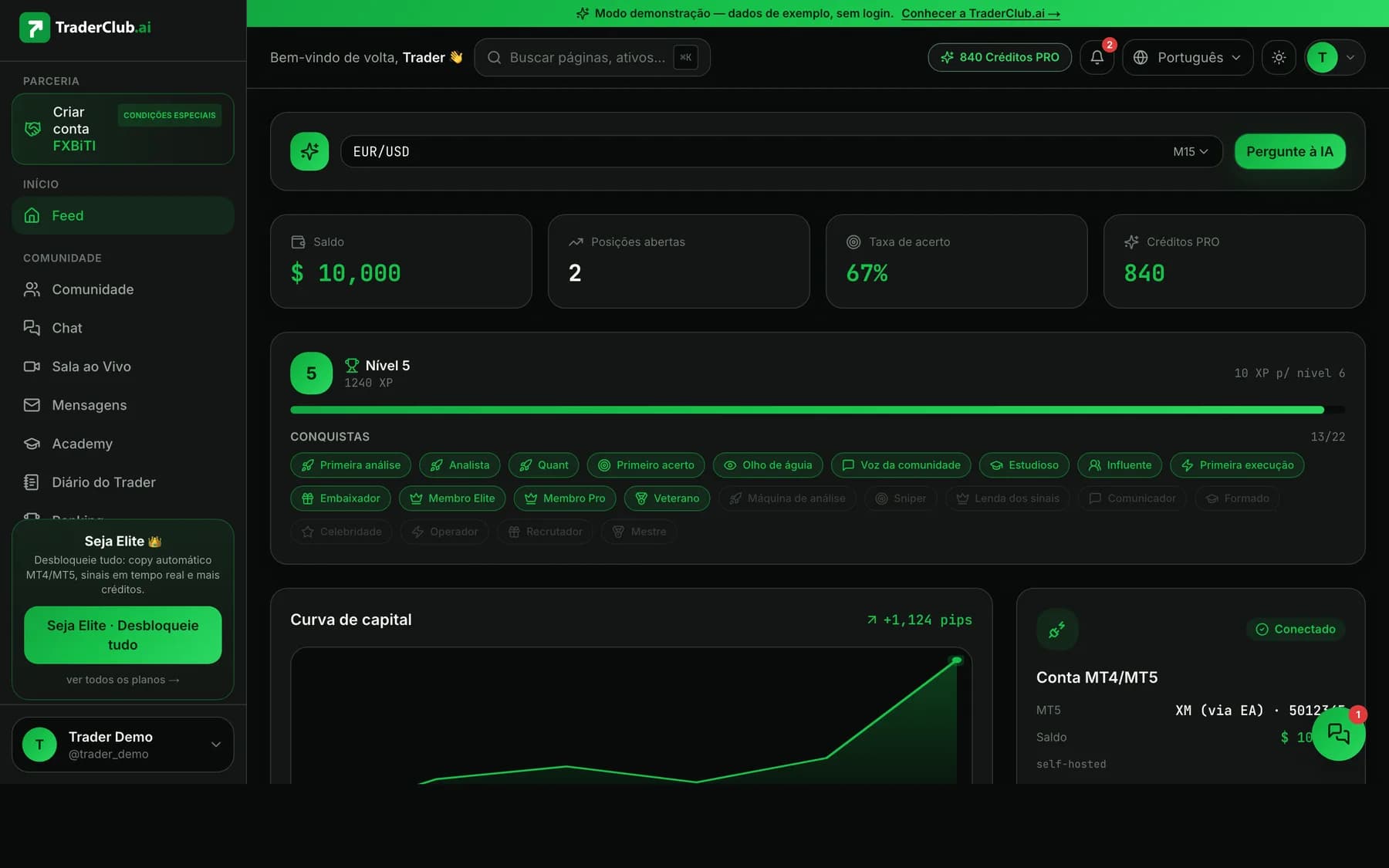
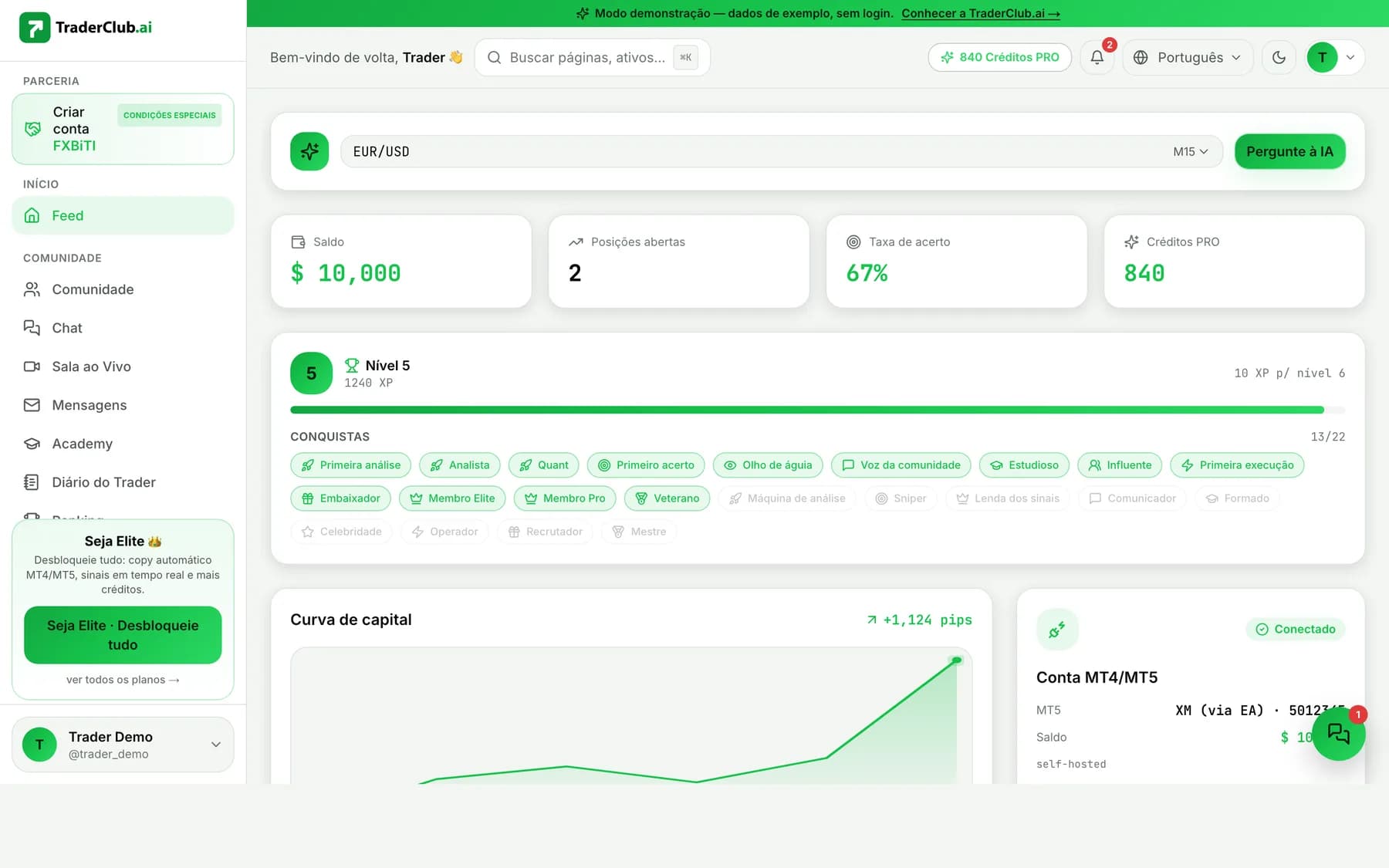
In TraderClub.ai, use the week to watch signals arrive in real time without executing any. Read every field: pair, direction, entry, stop-loss, take-profit. Open the corresponding chart and follow what happens next. You're calibrating your eye, not your account.
- Open a demo account with MT5 (realistic virtual capital: use the amount you would actually have).
- Learn the minimum vocabulary: lot, pip, spread, margin, stop-loss, take-profit, drawdown.
- Watch signals in real time without executing — note how price behaves after each one.
- Set up the H1 chart and understand why that timeframe is the confirmation reference.
Week 2 — Learning to actually read a signal
A signal is not an order to obey — it's a condensed thesis. In TraderClub.ai, every signal is born from a confluence analysis: EMA for trend, RSI for strength and exhaustion, MACD for momentum, ADX for trend quality. When the indicators disagree, there is no signal. When they agree, the thesis is still confirmed against the H1 timeframe before being published.
The most important field in a signal is not the entry — it's the stop-loss. It tells you where the thesis dies. A signal without a stop isn't a signal, it's a hunch. This week, follow ten to fifteen signals on the demo, executing exactly as published, no improvising: the exercise is learning what it means to follow a plan — and discovering how badly your hands itch to improve things mid-way.
Start a trade journal on the demo already: signal, time, what you did, what you felt like doing. In four weeks, that journal will say more about your future in trading than any equity curve.
Week 3 — Risk before returns
This is the week risk becomes configuration, still on the demo. Set your per-trade risk (0.5% to 1%), maximum daily loss (2% to 3%), lot cap and kill-switch — and configure it all in the TraderClub.ai EA, which runs on your own MT5 and enforces the limits before any order leaves. Zero-custody execution: your capital stays at your broker, in your account.
Keep following signals on the demo, now with the limits active. Notice one detail: lot size stops being your choice on each trade — it becomes the automatic consequence of the stop and your risk percentage. That silent change removes the single most emotionally contaminated decision from the table.
Get the next ones
One article a week, straight to your inbox. No spam.
Week 4 — The first real trade (small, and with criteria)
The first real trade only happens if three conditions are true: you followed the plan on the demo for two weeks without improvising; you understand every field of a signal without looking anything up; and your risk limits are configured and tested. If any one fails, stay on the demo another week or two. There is no prize for hurrying — the market will still be there next month.
Criteria met? Then the first real trade should be the smallest lot your broker allows, on a single signal, with every limit active. The goal is not to win: it's to execute the full process with real money and observe what changes in you. Something will — real risk plays with your head in a way the demo can never simulate. That difference is exactly what you're going out to measure.
| Week | Focus | Concrete goal |
|---|---|---|
| 1 | Platform and vocabulary | Demo open, zero trades, signals observed daily |
| 2 | Reading signals | 10–15 signals followed on the demo, no improvising |
| 3 | Risk as configuration | Limits set and active in the EA (risk, daily loss, lot, kill-switch) |
| 4 | First real trade | 1 trade at minimum lot — if the criteria are met |
The seven most common beginner mistakes
- Trading real money in week 1 — haste costs exactly what you can't afford: capital and confidence.
- Increasing the lot after a loss to win it back — the shortest path between an account and zero.
- Moving or removing the stop-loss mid-trade — the stop is where the thesis dies; without it, the account dies instead.
- Confusing demo luck with skill — ten wins aren't a sample, they're an anecdote.
- Trading every signal all the time — more trades isn't more edge; it's more cost and more noise.
- Ignoring the macro calendar — spread and slippage during events destroy the math behind any stop (that's why the AI vetoes those windows).
- Switching methods every bad week — no process survives being abandoned at its first drawdown.
What about after week four?
The roadmap ends; the process doesn't. The following month is deliberate repetition: the same limits, the same minimum lot, the same journal — until you accumulate a real sample. Risk increases, if they come, should be rare, small and scheduled (for example, reassessed every fifty recorded trades), never a reaction to a good week. A good week is noise; fifty trades start to be data.
And reread the journal monthly. The patterns that show up there — the hour you improvise, the kind of signal you skip, the urge to touch the stop — are your real adversary, and no AI solves that for you. This four-week roadmap doesn't end with you ready; it ends with you knowing exactly what is still missing. That's already more than most people can say.
If you need an external reference, use the public track record — not strangers' screenshots — and compare your behavior against the plan, not your returns against other people's. Returns on a small sample are a lottery; adherence to the process is the only metric you fully control in your very first month.
What the AI does for you — and what remains yours
The honest division of labor: the AI analyzes indicator confluence continuously and without fatigue, confirms against H1 without laziness and vetoes macro event windows without morbid curiosity. It's process consistency at a scale no human sustains alone. What remains yours: the risk you accept, the limits you configure, the decision to press the button — and the responsibility for the outcome.
Access to the signals, the AI analysis and the execution EA comes with the Pro (R$79) and Elite (R$112) plans, with the platform available in 7 languages and a community spanning 120+ countries. But this four-week roadmap works from any starting point: what it demands isn't a subscription — it's honesty with your own process.
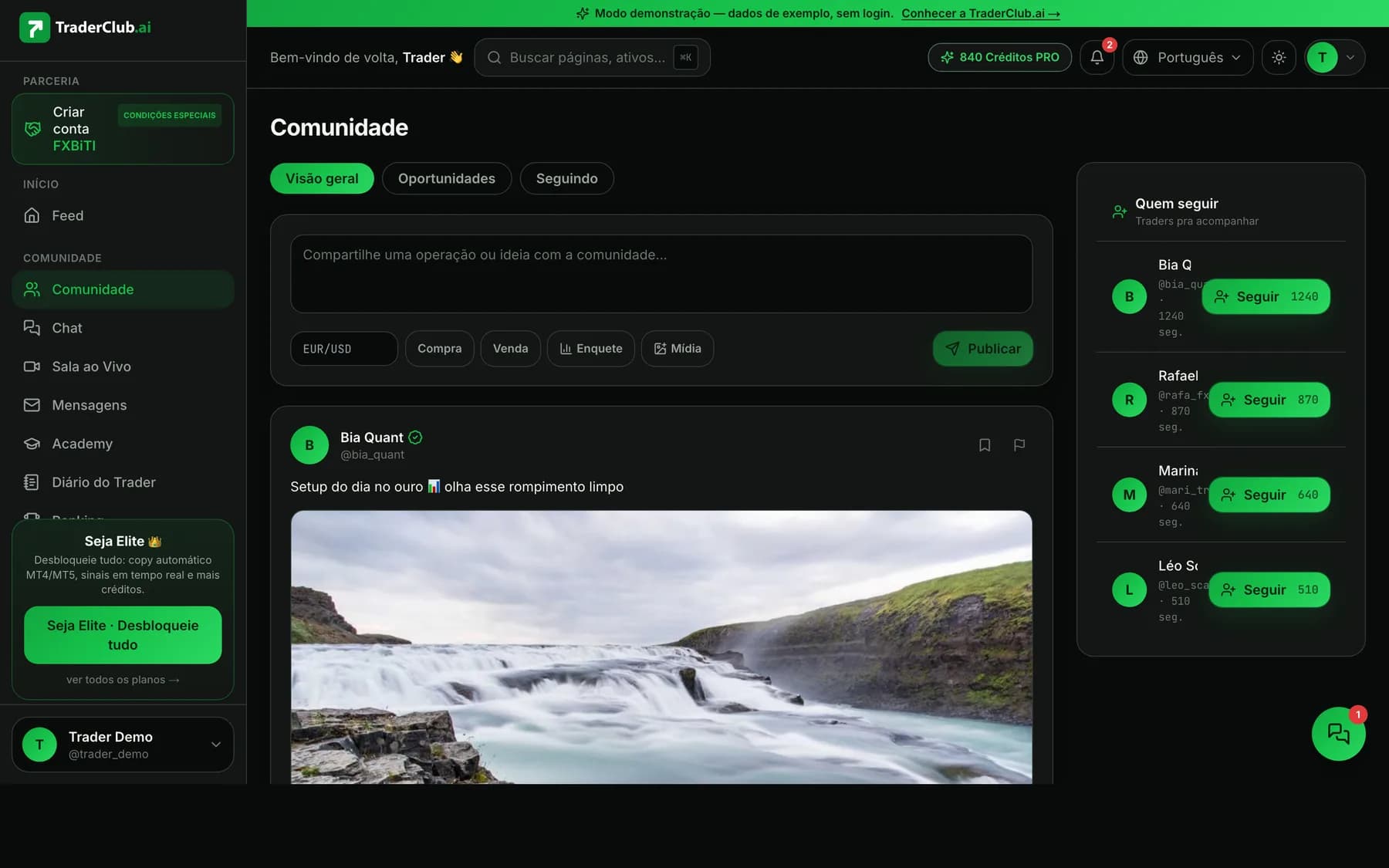
If you're going to start, start down the least glamorous path: demo, reading, risk, and only then a small first trade. TraderClub.ai was designed for exactly that process.
Risk warning: most people lose money trading in financial markets. Trading involves real risk of losing all invested capital, and no tool — AI included — eliminates that risk. This content is educational and does not constitute investment advice. Never trade with money you cannot afford to lose.