

Every retail trader has been there: a Telegram group with an aggressive name, a flood of profit screenshots, breathless testimonials, and an implicit promise — “join and we'll make you win”. Some pay to get in. Most leave months later with less money and a vague feeling that something was off, without being able to point at exactly what.
This article points at exactly what. It is not a piece against Telegram — it is a piece about the difference between evidence and narrative, and about how a signal seller's incentives shape what you get to see. By the end, you will have an objective standard for evaluating any signal provider. Including us.
A screenshot is not a track record
Start with the centerpiece of signal marketing: the profit screenshot. A screenshot is an image produced by someone with every interest in what it shows. It has no verifiable timestamp, shows nothing of what came before or after, and carries no binding link to the real market. Editing a screenshot is trivial; simpler still is just choosing which ones to show.
Then there is the structural problem of the channel itself: Telegram messages can be deleted and edited. A signal that went wrong vanishes from history in two taps. What remains in the group, months later, is a curated timeline — not a record. You are not looking at performance; you are looking at an edit of performance.
This has a name: survivorship bias. When only the wins survive into the record, any strategy looks brilliant. The history that matters is not the trades shown — it is all the trades, in the proportion they actually happened.
Follow the money: the incentives of signal sellers
The most revealing question about any signal provider is not “does he win a lot?” — it is “how exactly does he make money?”. The most common answers in this market draw an incentive map that rarely points at your results:
- Subscription without accountability: the seller gets paid the same whether the calls win or lose. The incentive is to retain subscribers — which is done with marketing, not necessarily with performance.
- Broker rebates (IB): the seller earns commission on YOUR traded volume. The more you trade, the more he makes — even while you lose. It is the industry's most perverse incentive, and the least disclosed.
- Cascading upsells: the cheap signal group is the doorway to the expensive mentorship, the “VIP group”, the “account management”. The signals do not need to work; they need to build an audience.
- Demo accounts and short windows: “live” results on a demo account, or one good month displayed as if it were the whole story.
When the product is the signal, the customer is the subscriber. When the product is the volume, the customer is the broker — and the subscriber becomes raw material.
None of these models makes a seller automatically dishonest. But all of them create an asymmetry: he knows the full history, you know the published version. Without a record he cannot edit, the entire relationship rests on the word of someone who profits from your staying.
What an auto-resolved result means
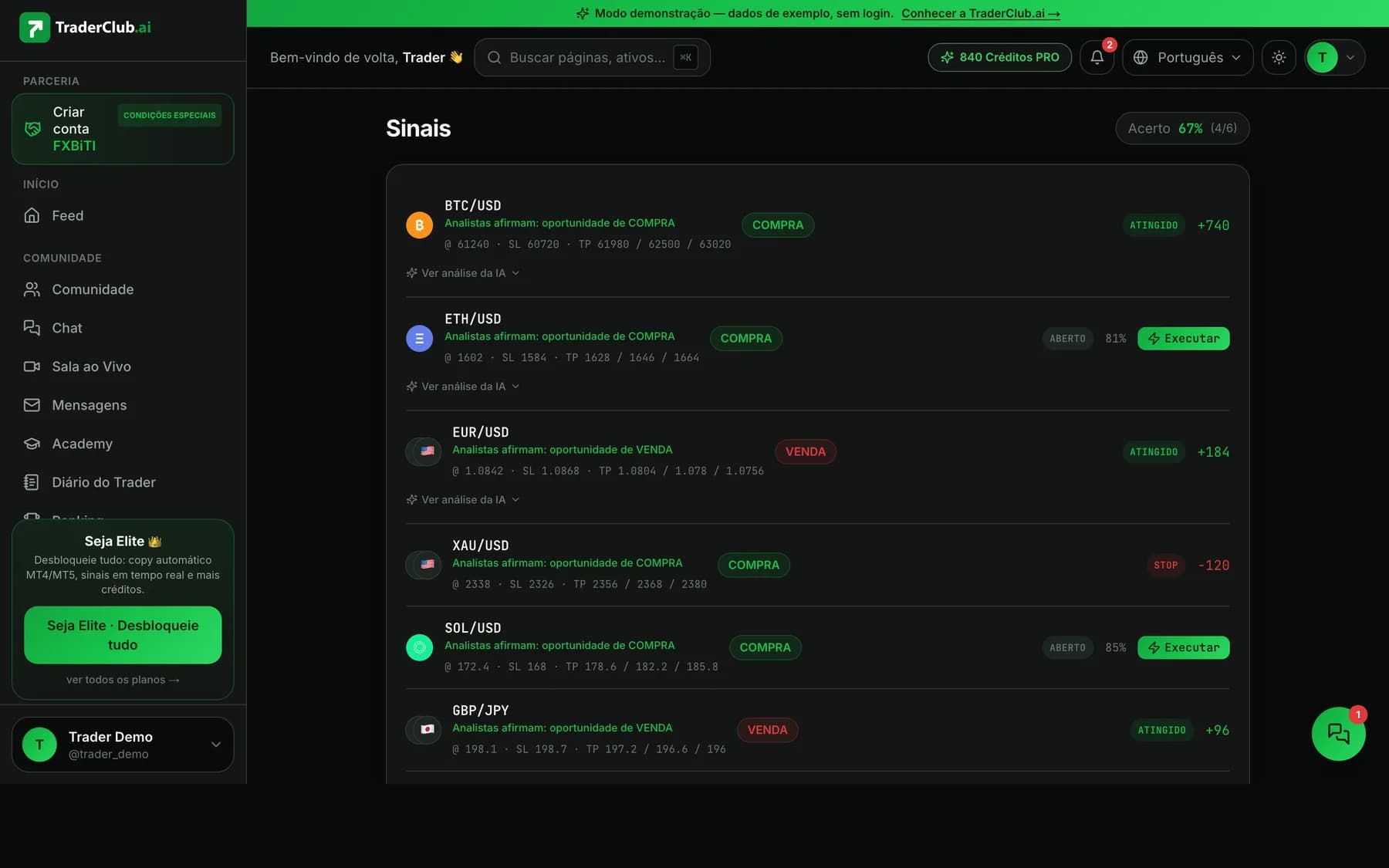
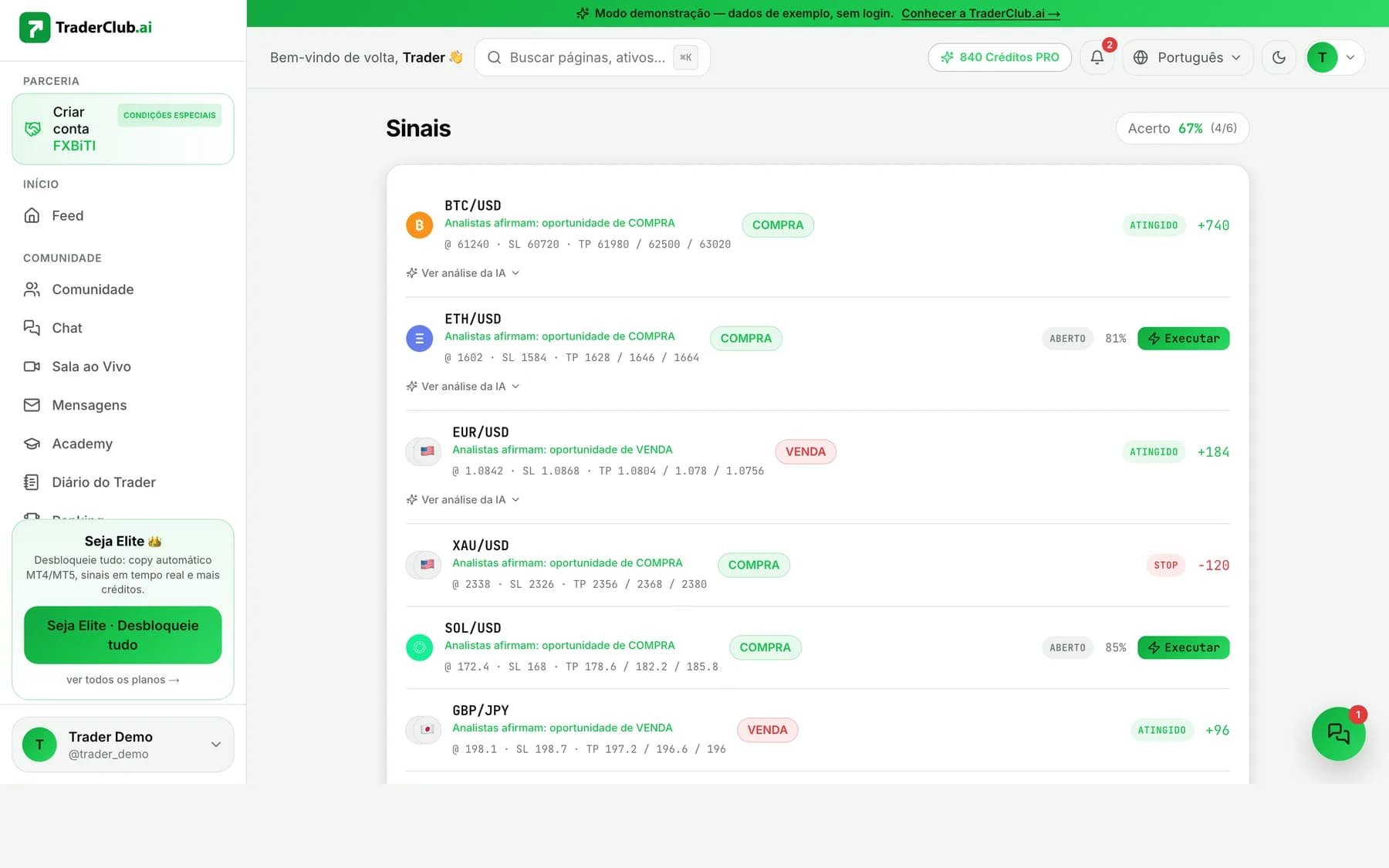
Now the other side of the comparison. On an auditable platform, a signal is recorded at the moment of publication with all its parameters: instrument, direction, entry price, stop loss, take profit, time. From that point on, no human touches the outcome. An automated system tracks real market candles and resolves the signal on its own: take profit hit means win; stop hit means loss; expired means recorded as expired.
This eliminates the two classic manipulations of the signal market: the “adjusted afterwards” result (the famous “you should have exited earlier, those who followed the management won”) and the deleted result. A published signal is a public bet with locked parameters — and the market, not the seller, delivers the verdict.
Get the next ones
One article a week, straight to your inbox. No spam.
Hash-chain ledger: why “auditable” is not a marketing word
Automated recording solves manipulation in the present. But what about the past? How do you know the history displayed today is the same one that existed three months ago? This is where the hash-chain ledger comes in — the piece that turns “trust me” into “verify it yourself”.
The mechanism is the same one underpinning blockchains: every record in the history carries a cryptographic fingerprint (hash) of the previous record. The records form a chain. Altering any old result — turning a loss into a win, removing a bad signal — would change that record's hash and break every following link in the chain. Tampering is not merely forbidden; it becomes mathematically detectable by anyone.
A practical test you can run on any provider: take an old signal from the history, open the instrument's chart at the recorded time, and check the candles yourself. If the history does not allow that exercise — no exact time, no parameters, no record of the losing signals — you do not have a track record. You have an advertisement.
The comparison, side by side
| Criterion | Telegram signal group | Auditable platform |
|---|---|---|
| Signal record | Editable, deletable message | Immutable record, parameters locked at publication |
| Result resolution | Screenshot chosen by the seller | Automatic, against real market candles |
| Complete history | Curated — losses disappear | Full: wins, losses and expiries, all public |
| Integrity of the past | Impossible to verify | Hash-chain ledger — tampering breaks the chain |
| Provider's incentive | Volume, upsells, retention through marketing | Flat subscription — no rebate on your volume |
| Risk management | “Manage your own bankroll” (you're on your own) | Per-trade limits, kill-switch, AI veto during macro events |
| Execution | Manual, chasing the message | Zero-custody EA in your own MT5, signed orders |
What to demand from any signal provider — including us
Keep this list. It applies to any service, in any market, in any language:
- A complete, public history, with losses displayed in the same showcase as the wins.
- Automatic resolution against real market data — no result declared by hand.
- An immutable or cryptographically verifiable record of the past (hash-chain or equivalent).
- Full parameters on every signal: entry, stop, target and time — before the trade plays out.
- A disclosed revenue model: if broker rebates on your volume exist, you deserve to know.
- Zero promises of returns. Anyone promising profit is violating the basics of seriousness (and, in many jurisdictions, of regulation).
- No requests for your broker credentials, ever, for anything.
Notice that nothing on that list mentions win rate. Win rate in isolation is the easiest number to inflate and the least informative: a strategy can win 80% of the time and destroy the account in the other 20%. What the list demands is verifiability — the precondition for any number, good or bad, to mean anything at all.
In defense of Telegram (yes, really)
Let's be fair: the problem was never the app. Telegram is an excellent community channel — fast conversation, reach, interest-based groups. The problem is using a chat as proof of performance. Those are different jobs: community is where traders share context and learn together; a track record is where performance is recorded in a way that nobody — not even the provider — can rewrite.
That is how TraderClub.ai is structured: the community lives on the platform, in 7 languages, with over 12.4k traders across 120+ countries — and the track record lives elsewhere, public, auto-resolved against real candles and protected by a hash-chain ledger. Signals come from confluence analysis (EMA, RSI, MACD, ADX) with multi-timeframe confirmation on H1, and pass through an AI risk veto during macro event windows. The chat is for talking. The ledger is for proving.
Don't take our word for it — that is precisely the point. The full history, with wins and losses resolved against real candles, is open for anyone to audit.
Risk warning: no signal provider — auditable or not — removes the risk of trading. Leveraged trading can result in the loss of your invested capital, and past results, however verifiable, do not guarantee future results. Use risk limits, start small, and never trade capital you cannot afford to lose.